
Replacing office ceiling tiles in Haifa: matching the panel, edge and grid
One damaged tile does not always require a new ceiling. Identify the panel, check the grid and compare a local replacement with a complete ceiling zone.
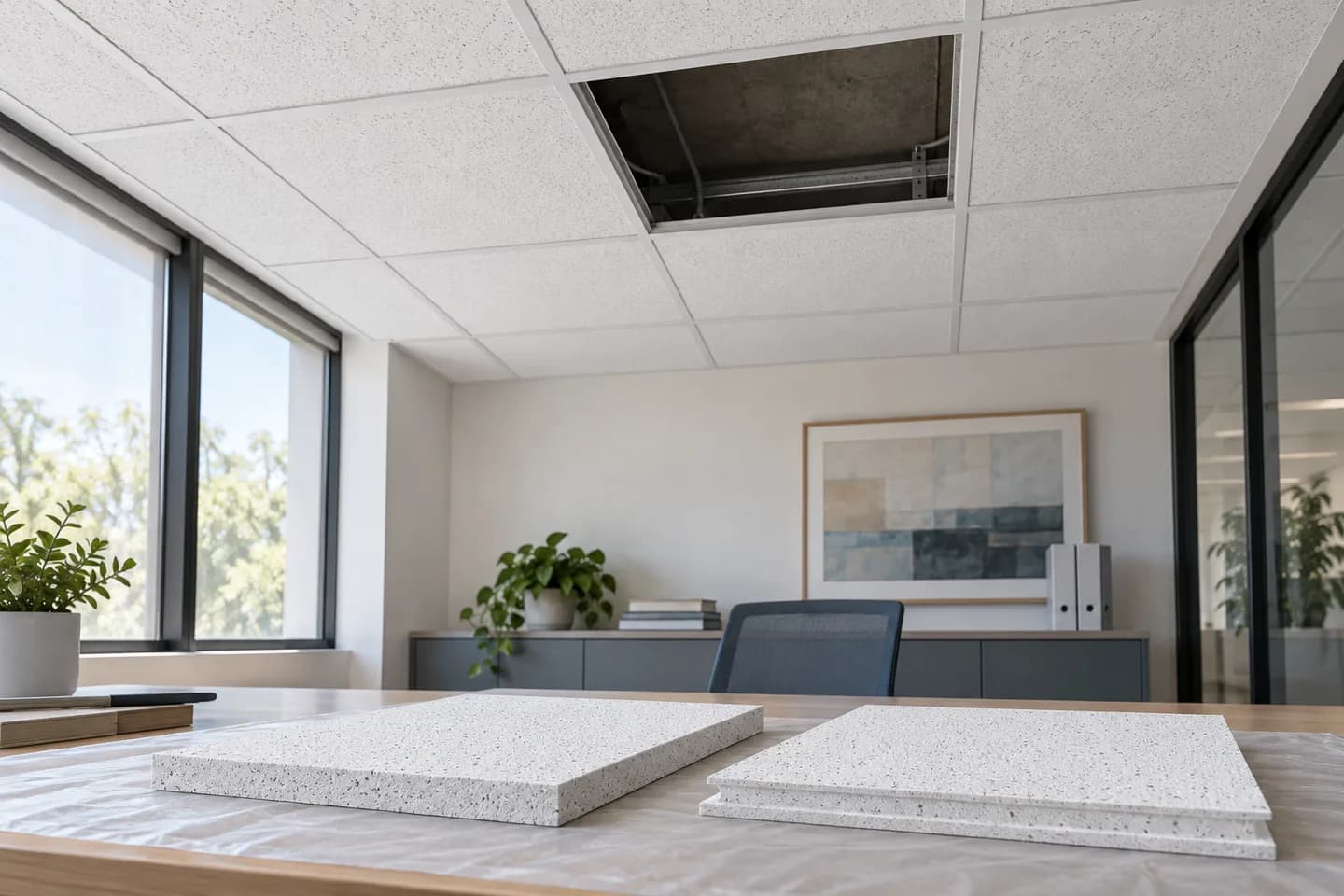
An office ceiling can look tired because of a few damaged panels while its supporting grid remains usable. The opposite can also happen: clean tiles hide a distorted grid or an unresolved problem above it. For an office in Haifa, start with an inventory rather than an order for a box of white squares. This guide explains what to record, when a limited replacement makes sense and how to define a finished result. It concerns accessible modular ceilings; a continuous plasterboard ceiling needs a different repair approach and should not be priced as removable tiles.
1. Identify the ceiling before shopping
Collect the manufacturer's name and any product reference from existing documents or an accessible spare panel. Photograph the complete room and the face of a sound tile. If no reference survives, record the pattern, texture, thickness and edge shape for a supplier to assess. Armstrong's replacement service also uses product identification and photographs to find a match. This is a useful identification principle, not a promise that an imported model is stocked locally. Do not buy an entire batch from a photograph alone.
2. Measure the module and the actual panel
The visible square between grid lines and the removable panel are related measurements, but they are not interchangeable purchasing descriptions. Ask the installer to confirm the actual panel dimensions, thickness and how it sits on the supporting tee. Keep both room layout and individual panel information in the request. A slightly different replacement can leave an awkward gap or fail to seat correctly. Where access is difficult, arrange identification during a site visit. Office staff should not climb on furniture or remove equipment simply to obtain a measurement.
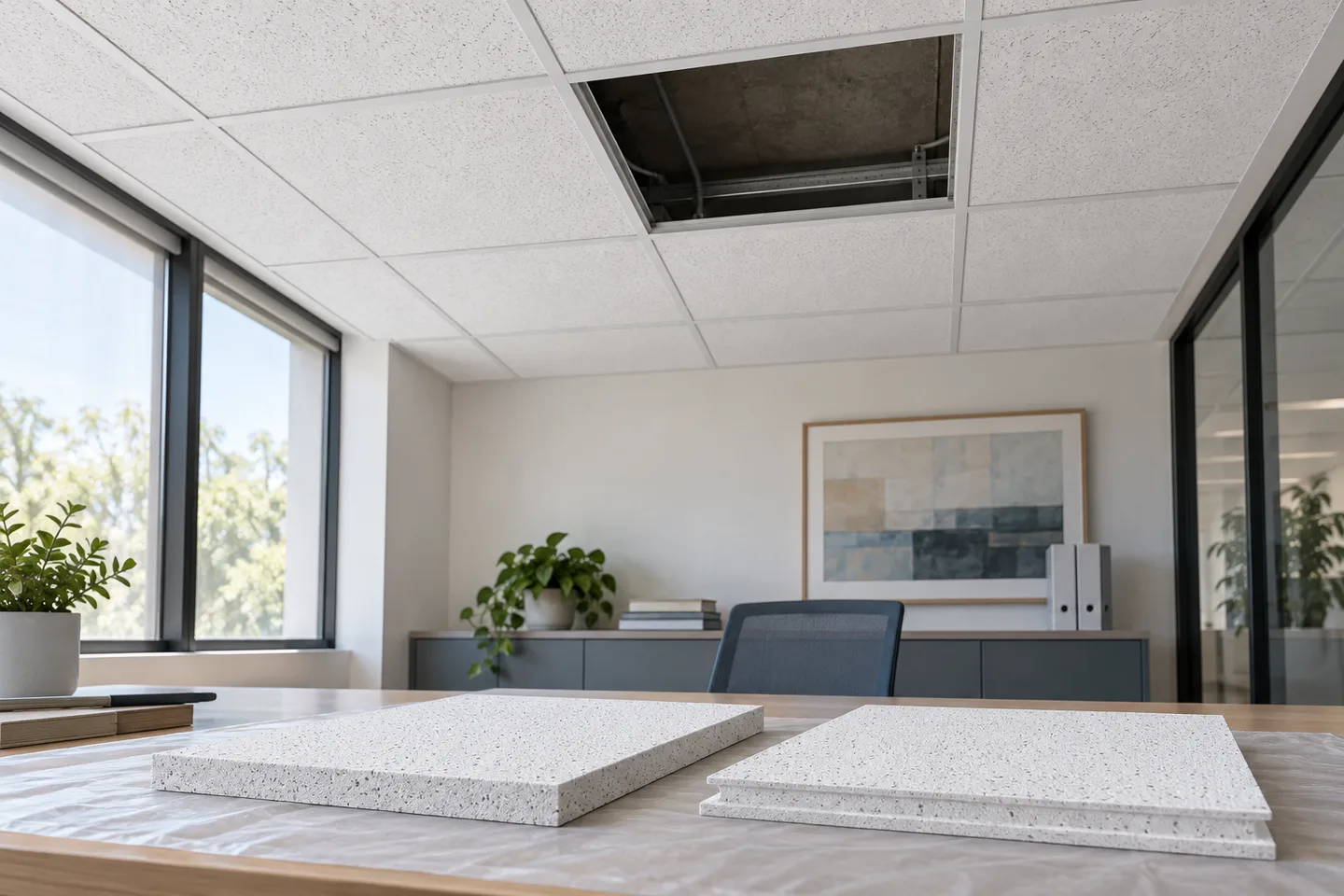
3. Match the edge as well as the colour
A flat edge and a recessed edge can create different ceiling planes even when their faces appear similar. Grid width, perimeter details and the selected tile must work together. Request a sample check in the actual grid before approving a larger order, particularly when the existing model is unknown. The test should include a normal full panel and any relevant border condition. A visually convincing sample placed on a desk does not establish fit overhead. Keep the confirmed product reference in the quotation so an alternative cannot silently replace it.
4. Establish why the old tile was damaged
A stained panel, a broken corner after maintenance and widespread sagging call for different next steps. Record where each defect appears and whether it has changed. If a stain is associated with an unresolved leak, replacing its visible cover does not complete the underlying repair. If the grid is bent, new tiles alone will not straighten the ceiling. Photograph the affected area before the relevant specialist intervenes, then agree when it is ready for finishing. The scope should distinguish a finished service repair from a decorative replacement, with responsibility clear for each stage.
| Option | Check first | Define in the quote |
|---|---|---|
| A few panels | Product and edge match | Quantity and visible differences |
| One complete zone | Boundary and adjacent panels | Finished room or ceiling field |
| Panels and grid repairs | Support condition | Separate repair and replacement items |
5. Compare a few panels with a complete zone
For one accidental break, a close replacement may be sufficient. Where the old face has aged differently, a new panel can remain visible even when the reference matches. Compare the cost and appearance of replacing the damaged panels, a coherent room zone or all panels within the existing serviceable grid. None of these options automatically includes a new suspension system. Use the comparison table to set the boundary before requesting prices. Agree what happens if an exact match is unavailable; this avoids discovering a mixed ceiling only after installation.
6. Protect access and the existing building systems
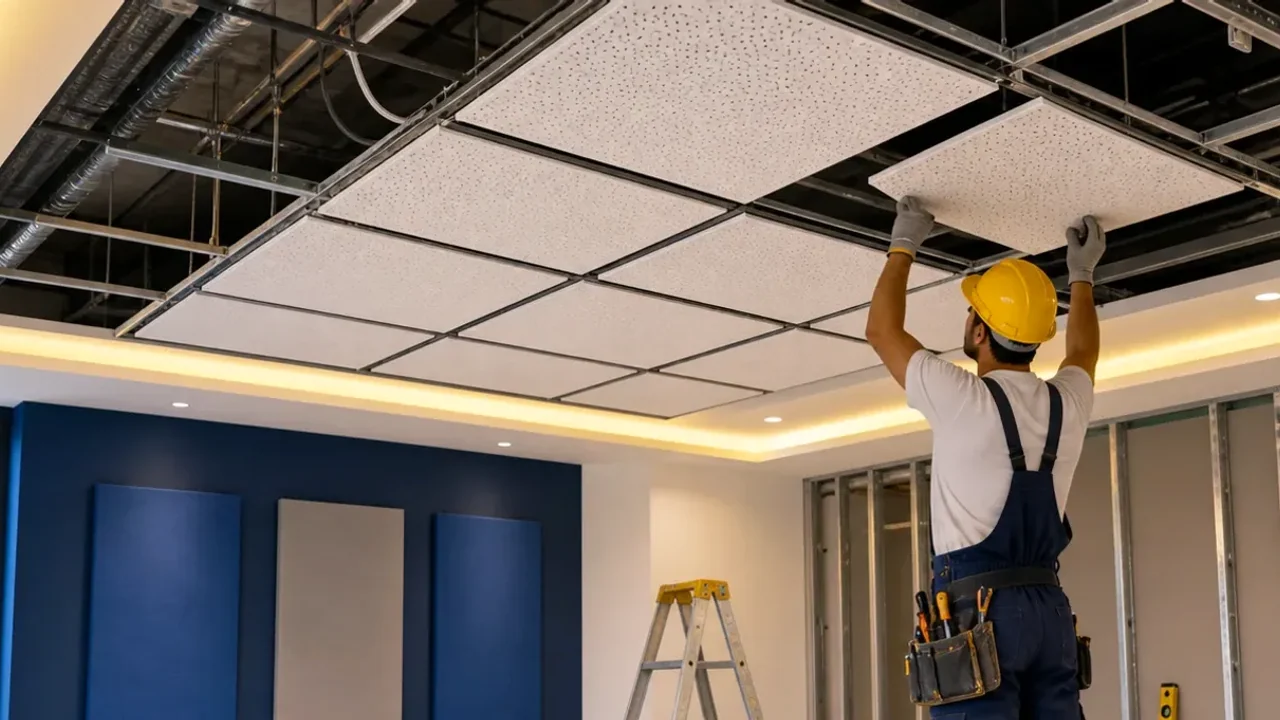
Locate lights, diffusers and other devices that share the ceiling layout. A replacement tile should not become an improvised support for equipment. Changes involving electrical connections, air conditioning or building safety systems need the appropriate specialist and the relevant system requirements. Ceiling finishing does not include those services automatically. Where a ceiling has documented performance requirements, confirm that the proposed replacement is compatible before substitution. A similar white face is insufficient evidence. The installer should identify uncertainty rather than assume the original specification from appearance or the age of the office.
7. Separate echo control from sound insulation
A ceiling tile selected for absorption inside a room is not automatically a solution to conversations passing between offices. If privacy is the real complaint, describe who hears whom, the partition arrangement and any shared void. This helps prevent buying new decorative panels for the wrong objective. Our acoustic ceiling service concerns the room's acoustic task; the meeting-room privacy guide explains a separate set of questions. Do not compare a tile replacement and a complete sound insulation system as equivalent quotations. For wider planning, compare the office ceiling brief and mineral and perforated ceiling systems before choosing a different product.
8. Do not assume repainting is an equivalent repair
Painting old panels can change their visible texture and may conflict with the manufacturer's instructions for the particular product. Before choosing it as an economy measure, obtain product-specific advice rather than a general promise that every mineral tile can be painted. If replacement is agreed, confirm the finish supplied and whether any grid decoration is a separate task. Include the existing ceiling under normal office lighting in the sample review. A new tile that looks identical in a warehouse can appear different beside its older neighbours in the room.
9. Plan the work around the actual office
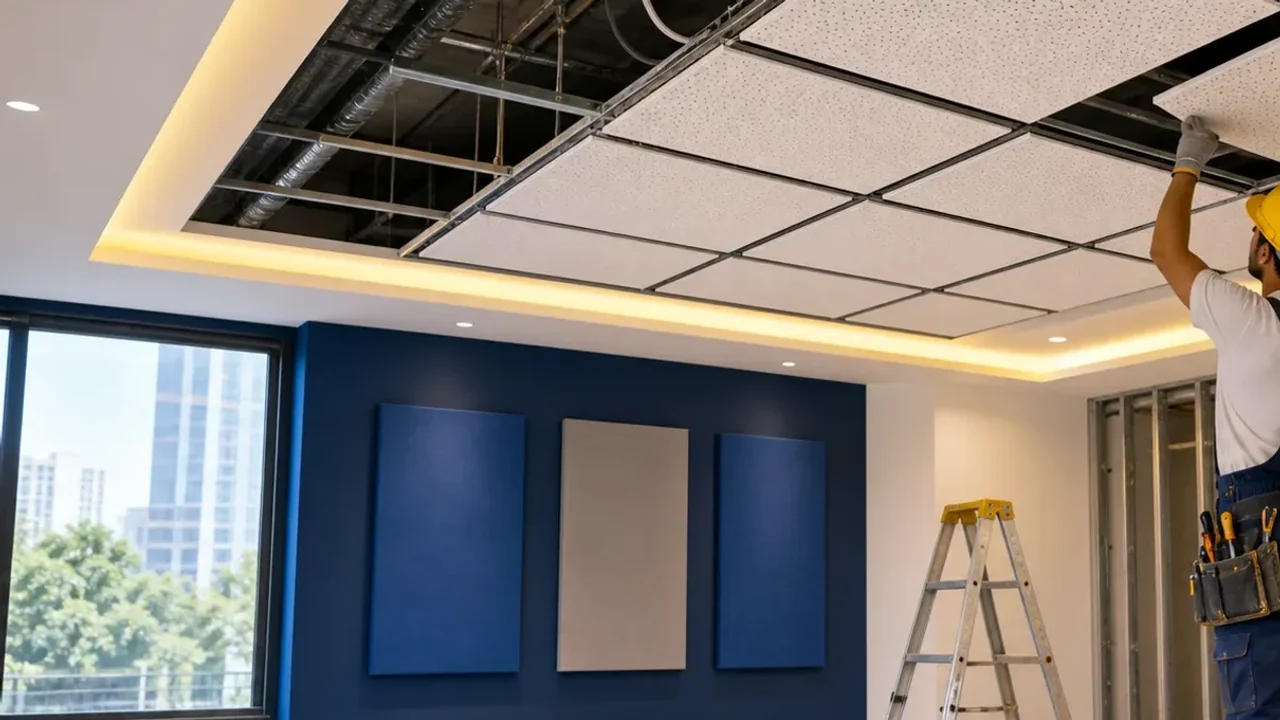
Divide the floor plan into work areas and identify desks, screens, meeting rooms and shared access that must remain usable. Agree which furniture is moved by the client and how retained equipment is protected. A small replacement can still need delivery arrangements and a clear working area underneath. Do not promise a disturbance-free office or a universal completion time from the panel count. A suitable sequence may involve completing one room at a time. For broader changes, use office interior renovation to define the connected work.
10. Ask for a quotation that describes the result
The request should list the confirmed panel, quantity, border pieces, grid repairs, protection, removal of agreed waste and any retained spare panels. Separate supply from other work so two offers can be compared fairly. Refer to the current price catalogue for existing service guidance; a product-specific replacement still needs its actual scope confirmed. State whether a sample is included and what requires another approval. The price of a square metre of a new ceiling does not automatically describe a small repair with matching and access constraints.
11. Inspect the completed ceiling and keep the reference
Check that panels sit consistently, edges are intact and the agreed room boundary has been completed. Review the result with the office's usual lights switched on. Confirm that maintenance access remains possible and that retained equipment is returned to its agreed condition by its responsible specialist. Keep the product label and a few agreed spare panels where appropriate; this can simplify the next accidental break. For an initial discussion with Nikolai, send the Haifa address, room overview, defect map and available model details. These are planning inputs, not evidence of a previously completed local project.
Questions
Can you match a tile from a photo?
A photograph helps identify candidates. Dimensions, edge and a sample fit may still be needed before ordering.
Does one stained tile mean the whole ceiling must go?
No. The cause, supporting system and availability of a suitable replacement determine the scope.
Will new panels stop conversations travelling next door?
That cannot be assumed. Speech privacy needs a separate assessment of the complete transmission path.
Can the office stay in use?
The working zones, protection and sequence can be discussed; uninterrupted use of every desk is not promised.
What should I send Nikolai?
The address, overview, affected areas, product reference if known and any constraints on office access.
Relevant services
Guides and practical notes


Message Nikolai on WhatsApp with photos and dimensions, or call him to discuss the next step and what is needed for an estimate.