Direct-bond drywall wall cladding in Or Akiva
Direct-bond drywall wall cladding in Israel: level concrete and block walls without a frame, save space, check moisture, outlets and paint-ready finish.
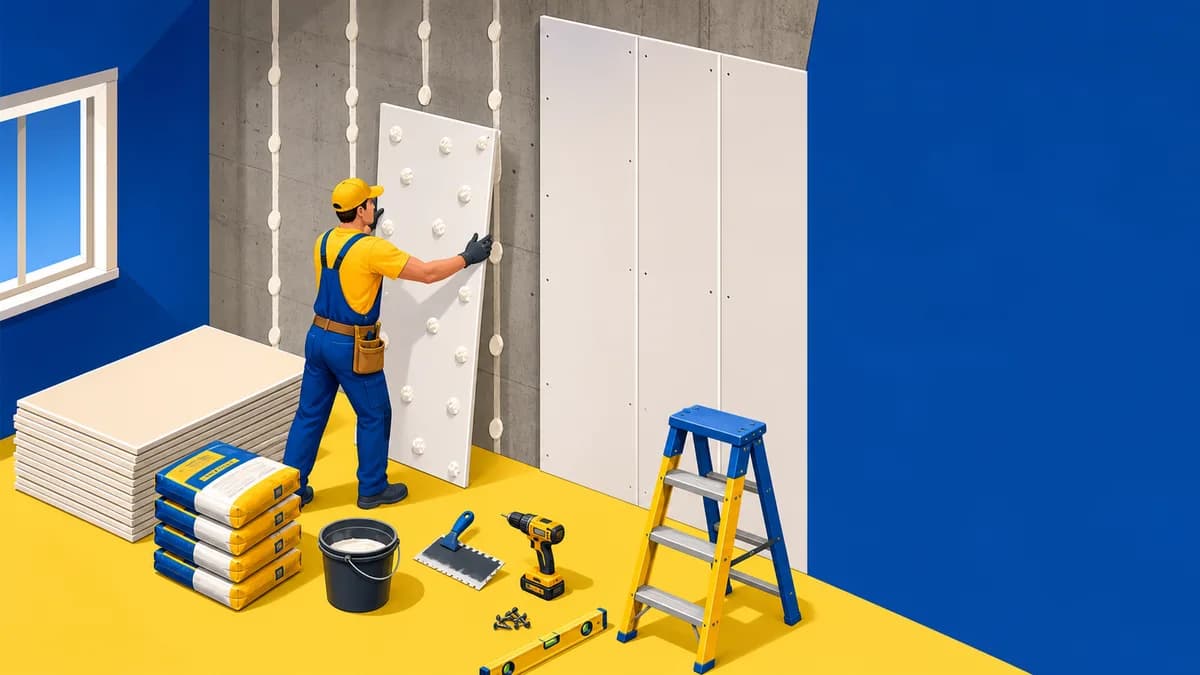
Direct-bond drywall wall cladding is useful when a concrete or block wall needs fast leveling without a metal frame and with minimal space loss. It is not a universal replacement for framed cladding: the substrate must be dry, sound and reasonably straight, while electrical points, loads and finish level should be clear before installation.
When direct bonding makes sense
Adhesive drywall is chosen when the wall is basically stable, deviations are moderate, no thick services need to be hidden and every centimeter matters. It can work well in bedrooms, corridors, rental apartments, small offices and areas where wet leveling would take longer.
When not to use adhesive boards
Direct bonding is risky with active moisture, weak plaster, flaking paint, deep hollows, structural cracks or many cables behind the wall. In those cases, framed cladding, substrate repair or another leveling method is usually more reliable.
Substrate inspection
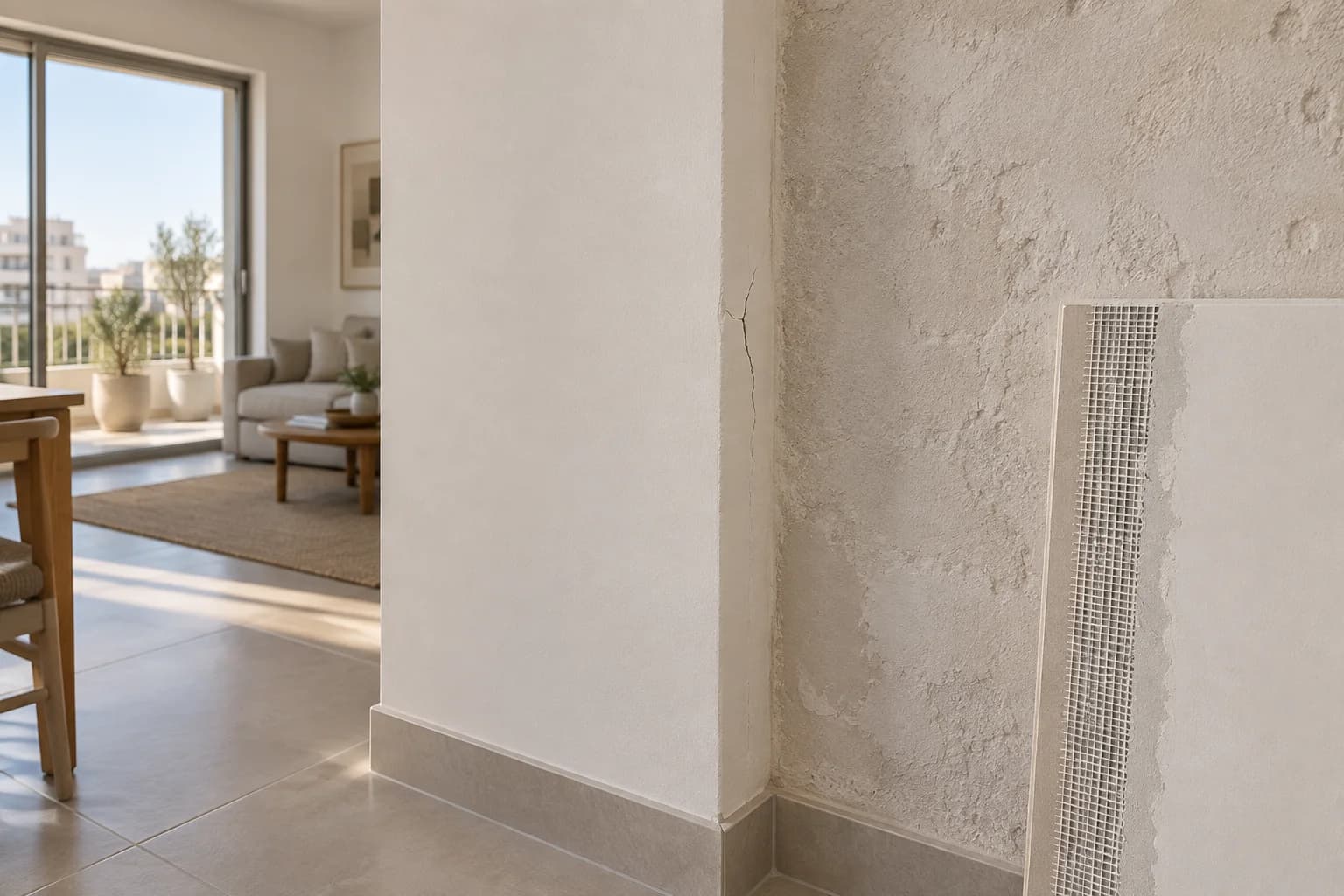
Before installation, the wall is tapped, cleaned of weak layers, checked with a straightedge and reviewed around corners, joints, damp areas and old paint. Adhesive is only as strong as the layer below it, so weak material must be removed, primed or handled with another system.
Wall deviations and adhesive thickness
Adhesive can correct small deviations, but it should not become a thick random layer behind every board. If the wall has deep hollows, a leaning plane or corners that are visibly out, the real build-up should be checked first, because a frame may be more reliable and more honest to price.
Installation and geometry
Boards are aligned to one plane, with verticals, bottom line, junctions and seams checked as work progresses. Adhesive dabs should compensate for wall deviations without turning the board into random packing. On a long wall, the first boards decide the whole line.
Moisture, primer and adhesion
In coastal and northern parts of Israel, an external wall should not be covered with drywall when active moisture, mold or leak marks are present. The substrate is cleaned of dust, absorbency is checked and primer is chosen for concrete, blockwork or old plaster; primer helps a sound layer, not a failing finish.
Electrical points and services
Direct bonding leaves little space behind the board, so sockets, switches, internet points, slim cables and small routes need to be decided early. AC pipes, thick cable bundles, power supplies and access points usually need framed cladding with proper service depth.
Wall loads
Light shelves and accessories can be planned with suitable anchors, but a heavy TV, cabinet, mirror or floating unit should be fixed into the original wall or supported by a planned reinforcement. The glued board itself should not be the only support for a serious load.
Israeli project practice
Around Haifa, Hadera, Harish, Caesarea and northern Sharon, direct-bond cladding is often selected for small rooms, older concrete walls and apartments where space is tight. Inspection should account for moisture at external walls, old paint, AC routes, tight schedules and work in occupied homes.
Finish and price
After bonding, the wall still needs joints, corners, primer, skim coat and painting. Price depends on more than square meters: substrate preparation, wall deviations, board count, access, sockets, junctions and the finish level under side light all affect the estimate.
Confirm the existing base before choosing glued lining · Or Akiva
Glued lining is assessed as a particular system on a suitable base, not a shortcut for covering every uneven wall.
Check the base and the required geometry
Identify loose layers, contamination, significant irregularity and any unresolved moisture issue. The proposed adhesive system needs a suitable substrate and an achievable finished plane. Ask what must be prepared before installation instead of assuming that boards will stabilise every old coating beneath them.
Compare space with future service needs
Show the desired face beside doors, windows and retained furniture. If new equipment, routes or substantial backing are required, compare a system designed for those needs rather than choosing solely by apparent thinness. The smallest-looking construction is not automatically the most suitable complete option.
Include reveals and perimeter finishing
A glued wall face still meets existing corners, skirting and openings. Define these transitions and the painting boundary in the proposal. Compare local preparation, glued lining and a framed alternative for the same result, with differences in substrate work made explicit.
Keep the chosen product system clear
The installer should identify the compatible system and its application conditions. The client does not need a generic do-it-yourself adhesive recipe. At completion, inspect geometry and agreed junctions, while keeping the specification for future changes to the lined surface and its fittings.
The room and address · Or Akiva
For an Or Akiva room where preserving width matters, compare the actual finished lining against retained furniture and door movement. If the wall has several old layers, show their condition before asking for the thinnest solution. The quote should separate necessary base preparation from the new face so a low lining price does not conceal unpriced corrective work.
Improve the wall without losing the room's useful dimensions
When lining a retained wall in Or Akiva, record the new finished plane relative to sockets, skirting, door reveals and furniture. One wall can be straightened while adjacent surfaces stay, but the corners then need a deliberate transition. Show the substrate and any known past repair separately from the desired appearance. If a loose or active problem remains, it is assessed before being covered. Compare the space occupied by the chosen system with the actual clearances in the room, rather than treating every lining as the same thin decorative layer.
Define the work boundary inside an occupied property
Mark the surfaces that change and the surfaces that stay on the same room plan. State whether the family or staff will use adjacent rooms, who clears the work area and when furniture returns. A small intervention can still affect a wall, floor junction or ceiling outside its visible outline. Ask the quotation to name those connections and the finished boundary. The neighbourhood name is an address reference, not a diagnosis of the substrate or a basis for an automatic surcharge. Additional work is agreed before it begins.
Compare a complete scope
Scroll the table horizontally to see all columns.
| Decision | What to define | Agreed result |
|---|---|---|
| Base | Stability and suitability | Preparation stated |
| Geometry | Required plane | Actual finished dimensions |
| Alternative | Services or backing needed | Compare an appropriate frame system |
Questions before agreeing the work
- Can boards be glued over any old paint?
- No such universal assumption is appropriate; the base and selected system must be assessed.
- Is it always the thinnest solution?
- The finished build-up depends on the actual wall and the chosen compatible system.
Customer reviews of Nikolai's work
Read all reviews on our site8/10MidragThe low ceiling to hide the air conditioner in the kitchen and living room, including high-quality hidden openings in special sizes.Translated review excerptNikolai came and was very helpful in solving the problem in the kitchen, but then we waited more than a month and a half for the work to be done. Finally, the quality of work is perfect.
ש. כ. בנימינה. · Midrag · Read on Midrag
9/10MidragRepair of drywall niches in a very high ceiling following a leak from the roof. The repair and painting of the living room required work with scaffolding. In addition, plastering works due to moisture from the windows and walls.Review summaryFollowing a roof leak, Nikolai repaired drywall niches and a high ceiling, then painted the living room. The customer highlighted his responsibility and the team's workmanship.
מוטי ל. · Midrag · Read on Midrag
5/5EasyReview summaryQuality, timing, reasonable pricing.
Мариам В. · Easy · Read on Easy
Planning a job in Or Akiva
Address and access
For a property in Or Akiva, provide the exact address, floor, lift access, unloading options and permitted work hours. These details are checked before arranging a visit and defining the quote.
What to send for an initial estimate
Send a wide view and close-up photos of the work area, approximate dimensions, substrate condition and the result you want. Note any finished surfaces needing protection and work already assigned to another trade. The final scope is confirmed after a site check.
Send photos, dimensions or a short description. A quick call helps understand the construction type, rough budget range and whether an on-site survey is needed.
Relevant services
Estimated prices
Questions
How is direct-bond drywall different from framing?
Direct bonding is thinner and faster because the board is fixed straight to the wall. Framing takes more space but gives room for wiring, mineral wool, pipes, backing and larger wall deviations.
Can drywall be glued over old paint?
Only after checking it. If paint is loose, peeling or sitting over hollow plaster, it must be removed or the substrate must be strengthened. Adhesive cannot make a weak layer reliable.
Is it suitable for a damp wall?
No. Active moisture should not be covered with drywall. The source must be found, the wall dried and the correct material selected first, otherwise the board, adhesive and finish will fail.
What should be checked on exterior walls or near windows?
Leak marks, condensation, mold, salts, loose plaster and strong side light should be checked. On exterior walls in Israel, the problem is often the substrate rather than the board; if the layer is damp or separating, direct bonding only hides the defect until the next wet season.
How much space is lost?
Usually less than framed cladding, but the exact thickness depends on wall deviations and adhesive dabs. When deviations are large, the space saving becomes smaller and a frame may be the more honest solution.
How do you know the wall is too uneven for direct bonding?
The wall is checked with a straightedge, at corners, near the floor, near the ceiling and under side light. If boards need very thick adhesive dabs, the result may have voids, weak geometry and questionable pricing. Framing or substrate repair should then be considered.
When is framing better than adhesive?
Framing is better for large wall deviations, damp or weak substrates, many services, insulation, acoustic layers, access panels or planned backing for heavy mounted items.
Does the wall need primer before bonding?
Usually yes, but primer is selected after checking the substrate. Dusty concrete, weak plaster and old finishes behave differently, so primer does not replace a proper strength and adhesion check.
Can wires be hidden behind glued boards?
Small cables and prepared points can be planned, but there is limited depth. If many electrical routes, AC lines or power supplies need to be hidden, framed cladding is usually better.
Can a TV be mounted on this wall?
Yes, if the fixing reaches the original wall and the load is planned in advance. For heavy TVs, cabinets and floating units, reinforcement or another cladding build-up should be considered early.
Does the whole board need skim coating?
For high-quality painting, the whole plane is usually prepared, especially with side light. Technical areas can use a simpler finish, but this should be clear before pricing.
Which photos help with an estimate?
Send a wide wall view, side light along the wall, corners, top and bottom junctions, sockets, moisture marks, old paint, future furniture and TV location. A short video along the wall helps judge deviations.
Guides and practical notes