Drywall Partition Cost per Square Metre in Israel: What's Included
Drywall partition cost per square metre from the NikoGips price list: 228–348 ₪ standard, what is priced separately, two worked examples and a quote checklist.
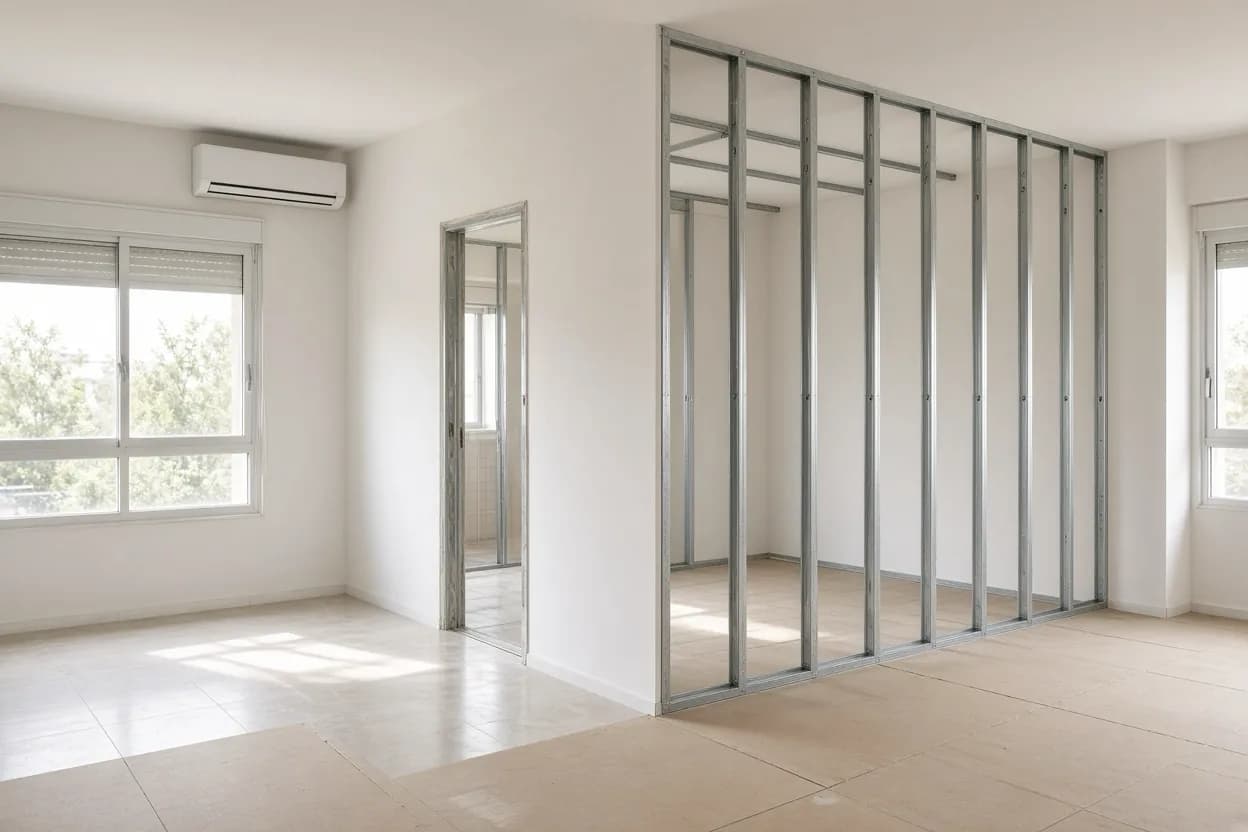
Drywall partition cost per square metre is usually the first number people look up when they want to divide a room, add a second kids' bedroom, build a home office or close off a meeting room. But the per-m² figure is only a starting point. Two quotes with the same rate per m² can end up at very different totals: one already includes a reinforced door opening, rock wool and a skim coat to paint-ready, while the other prices only the frame and boards and leaves everything else to "extras" that appear once the wall is standing.
This guide explains how a partition is measured (length times height, floor to ceiling), what a base price normally covers and what shows up as a separate line, and when it is genuinely worth moving up from a standard single-layer partition to a double-layer or acoustic one. All prices here are ranges from the NikoGips price list (November 2026). They show the order of magnitude, but the final quote depends on what a site survey finds: the real height, the condition of the floor and ceiling, window positions, electrics and air conditioning. Further down: a price table, two worked examples, a checklist for comparing quotes line by line, and what to send for a detailed estimate.
1. Drywall partition cost per square metre: how the area is measured
A drywall partition is normally priced per square metre of wall: the length of the partition multiplied by its height from floor to ceiling, or up to an existing suspended ceiling if that is the agreed working height. The area is measured on one face of the wall, but the per-m² partition rate covers the whole wall: top and bottom tracks, studs, and boards on both sides. That is why a square metre of partition costs more than lining an existing wall on one side only. Make sure your quote says the same thing, because an unusually low rate is sometimes a one-side price.
Three measuring questions that change the total
- Real height. Measure at several points along the line. In a new apartment the height is usually even, but in an older building in Haifa or the Krayot the ceiling can drop a few centimetres from one side of the room to the other, which affects cutting and time.
- Openings. Is the area of the door or window deducted from the square metres, or is the wall measured gross with the opening priced on top? Both methods are common, but you need to know which one you are looking at when comparing two quotes.
- Small quantities. On a partition of one or two metres, travel, set-up and finishing are not spread over many metres, so the effective rate per m² will sit nearer the top of the range.
Before you ask for a quote, mark the partition line on the floor with masking tape, photograph it from both sides, and measure length and height. That way every contractor prices exactly the same wall, and the quotes become comparable. If you want to understand the cost structure of drywall work more broadly, the drywall renovation cost calculator guide shows how separate lines add up to one estimate. A general description of partition types and the work itself is on the drywall partitions service page.
2. Drywall partitions price table (NikoGips price list)
The table brings together the ranges from the NikoGips price list for November 2026 for everything that usually appears in a partition quote. The ranges are deliberately wide. The low end fits a straight, accessible wall of reasonable length in an empty room. The high end fits unusual heights, many cuts and corners, work in a home people are living in, or difficult access to the floor. The final price is set only after someone has seen the site.
| Item | Unit | Price range (₪) |
|---|---|---|
| Standard drywall partition, one layer each side | m² | 228–348 |
| Double-layer partition | m² | 336–516 |
| Acoustic drywall partition | m² | 384–660 |
| Moisture- or fire-resistant board work | m² | 276–408 |
| Curved partition | m² | 432–780 |
| Office partition package | m² | 336–624 |
| Door opening in a partition | unit | 900–1,620 |
| Interior window in a partition | unit | 1,020–1,980 |
| Mineral (rock) wool acoustic insulation | m² | 102–192 |
| Skim coat on drywall under paint | m² | 66–132 |
| Interior wall painting | m² | 54–114 |
| Corner bead | linear m | 45.6–84 |
| Site survey | visit | 360 |
| Online consultation and detailed estimate | — | free |
Watch the units. Skim coat and paint are counted per square metre of finished surface, and a partition has two surfaces. A 10 m² wall can appear in a quote as 20 m² of skim coat and 20 m² of paint. That is not inflated quantity, just two sides, but check that every quote you compare counts the same way. Also check whether the prices include VAT or are quoted before VAT: that changes the comparison more than any difference between contractors. The full price list, including work not related to partitions, is on the drywall work prices page.
3. Partition wall with a door: opening price, reinforcement and what's not included
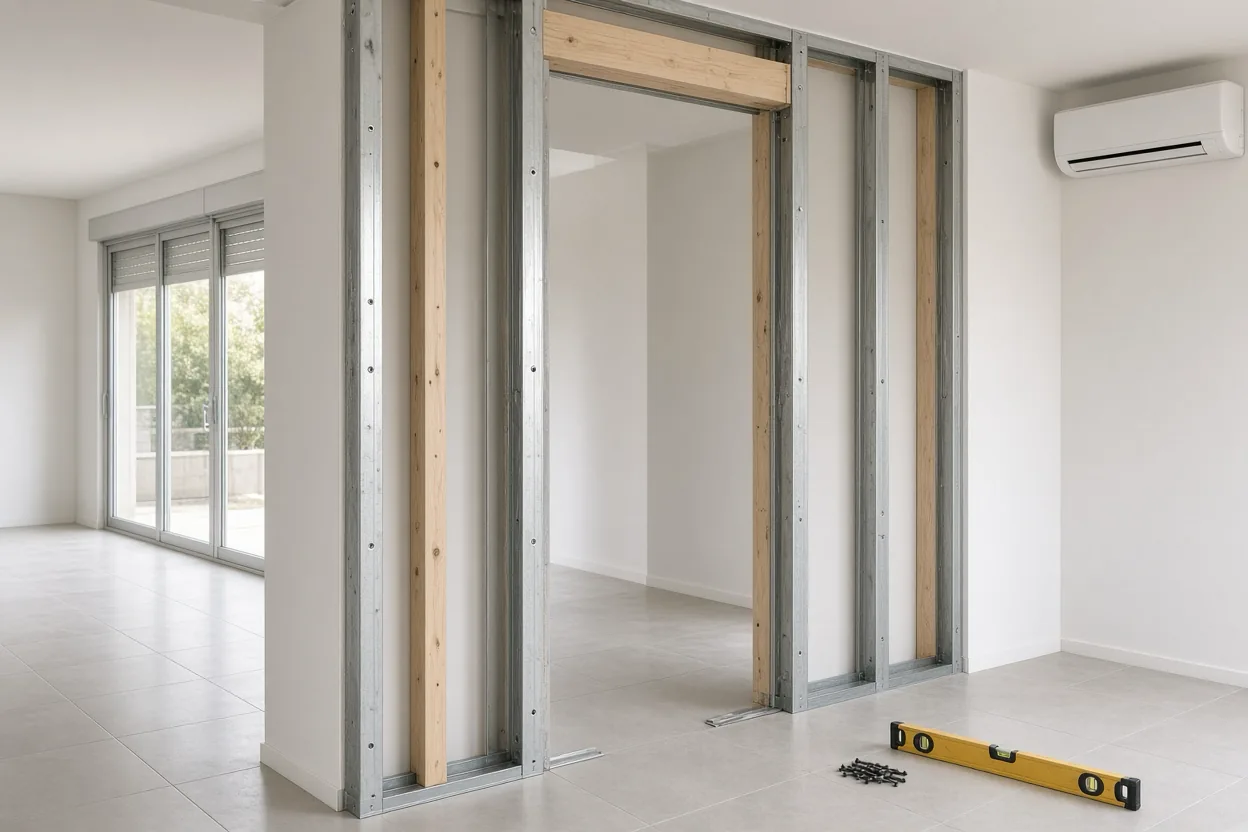
The door opening is the most heavily used point of any partition, which is why it is priced separately: 900–1,620 ₪ per unit on the price list. On that line you pay for the work around the opening, not for the door itself. A door is opened and closed thousands of times, slammed by a draught and leaned on. If the studs on either side are ordinary studs like the rest of the wall, the frame will move, cracks will appear at the top corners of the opening, and the door will start to rub or stop closing properly.
What a good opening needs
- Reinforced studs on both sides: a doubled stud, a heavier profile or timber inside the profile, depending on the system and the weight of the door. They are fixed to the floor and ceiling, not just to the tracks.
- A horizontal header above the opening that carries the section of wall over the door and keeps the frame square.
- A floor track cut cleanly at the opening, so no metal threshold is left at the entrance to the room.
- An opening width and height set by the frame and door you have actually chosen, not "roughly, we'll make it fit".
That last point is the source of most problems. The door leaf and frame are usually bought from a door supplier rather than from the drywall contractor, so the door is chosen before the wall is built: a standard frame or one with a seal, a pocket door that slides into the wall (which needs a thicker partition and its own design), the opening side, and the light switch position so it does not end up behind the open door. If the door arrives after the opening has been boarded and skimmed, all you can do is hope the dimensions match. Ask the quote directly: is fitting the frame included, who supplies the door, and who is responsible if the size is wrong. Examples of planning a room with a door are in the guide to a drywall partition with a door in Hadera.
4. Interior windows, curved sections, special boards and corners
Not every partition is a straight wall from floor to ceiling. Each of the following elements adds a line to the quote, and it helps to know in advance why it costs money and what to check.
Interior window
An interior window in a partition (1,020–1,980 ₪ per unit) is common in offices and in rooms created by a division, to borrow light from the space with an outside window into the new room. The work includes framing, reinforcement and a header, much like a door opening. The glass or a ready-made frame is often supplied by a glazier or aluminium supplier, so check who measures, who supplies, and whether the glass suits privacy (frosted or with a band) and safety in a room where children play.
Curved section
A curved partition (432–780 ₪ per m²) needs bent tracks, closer stud spacing and boards suitable for bending. It is slow work, and its finish is especially sensitive to side light. It is justified when the curve genuinely serves the layout, for example a soft transition in a corridor, rather than as a decoration that doubles the cost of the wall.
Moisture- or fire-resistant boards
If the partition borders a shower, a kitchen next to the sink or a laundry room, or if an office has a documented fire requirement, suitable boards are used (276–408 ₪ per m²). Details are on the moisture- and fire-resistant drywall page. Remember: moisture-resistant board is not waterproofing, and a wet area still needs its own waterproofing layer.
Exposed corners
A partition that stops in the middle of a room creates a free end with two external corners, and each corner gets a corner bead (45.6–84 ₪ per linear metre). On an end 2.7 m high that is 5.4 m of bead: 5.4 × 45.6–84 = roughly 246–454 ₪.
5. What the base price includes and what is a separate line
The most common confusion when comparing quotes is the assumption that the per-m² rate includes "everything up to paint". In most quotes the base partition price covers the frame (tracks and studs), standard 12.5 mm boards on both sides, fixings and usually tape with a first fill on the joints. Everything else depends on the wording. Go through this list and mark, for each quote, whether the item is included, priced separately or not mentioned at all:
- Framing and reinforcing the door opening, and supplying the door leaf and frame (usually from another supplier).
- Interior window: framing, plus glass or frame.
- Rock wool inside the cavity.
- An extra board layer on each side (double-layer partition).
- Moisture- or fire-resistant boards where needed.
- Curved sections and corner beads on free ends.
- Full skim coat to paint-ready, and painting.
- Electrical points: sockets, switch, lighting. The drywall contractor leaves openings and back boxes as agreed, but pulling cable and connecting is an electrician's job.
- Air conditioning and ventilation for the new room: an AC technician, and sometimes a design.
- Removal of debris, packaging and board offcuts.
- Protection of floors, furniture and walkways when people live in the home during the work.
None of these items is "suspicious" when it appears separately. Quite the opposite: a quote that lists them is easier to check, and you can see straight away what you could drop. The problem starts when a cheap quote simply does not mention them, and they come back as an extra after the frame is up and you have no bargaining power left. If the partition is part of a wider renovation, the drywall work page explains which jobs are usually combined into one visit to save an extra call-out.
6. What goes inside the wall: rock wool, electrics and reinforcement
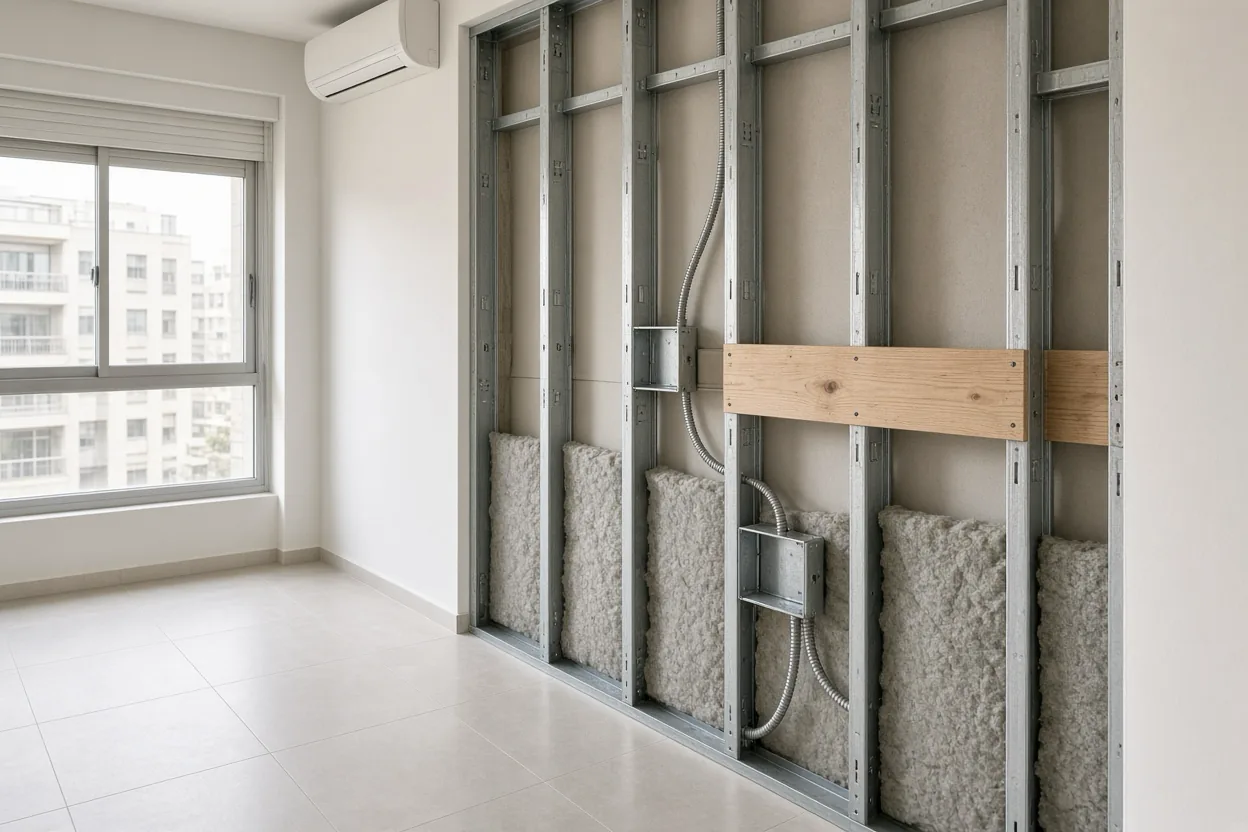
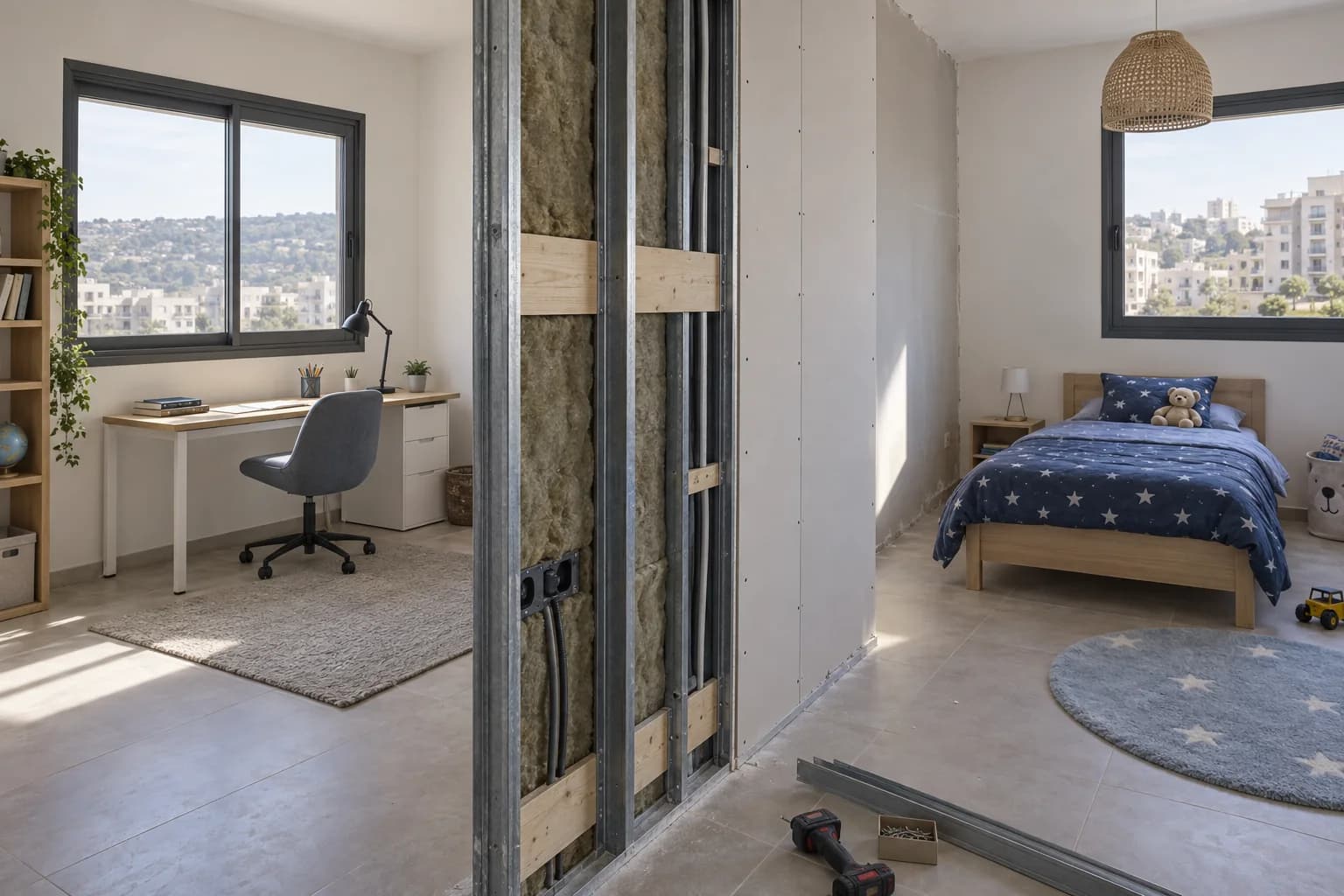
The most important moment in a partition's life is when one side is boarded and the other is still open. Anything that does not go into the cavity now will cost far more later, because you will have to open the board, repair it, skim it and repaint. So the contents of the wall are planned before it is closed, not improvised on installation day.
Rock wool
Rock wool in the cavity (102–192 ₪ per m²) absorbs sound in the air gap between the boards and damps the resonance of the wall. Between two bedrooms, or between a kids' room and the living room, it is the difference between a wall that passes every word and one where ordinary conversation sounds muffled. The wool should fill the cavity with no gaps between slabs and without being over-compressed. In an acoustic partition, check whether the wool is already included in the wall rate, so you do not pay for it twice.
Electrics and data
On the open wall, mark every socket, switch, network point and TV point. The electrician runs conduit and fits back boxes, and the drywall installer cuts the boards precisely around them. Every back box is a hole in the board, so two boxes back to back at the same point on both sides of the wall let sound through almost unhindered. It is better to move one of them into the next stud bay.
Reinforcement for loads
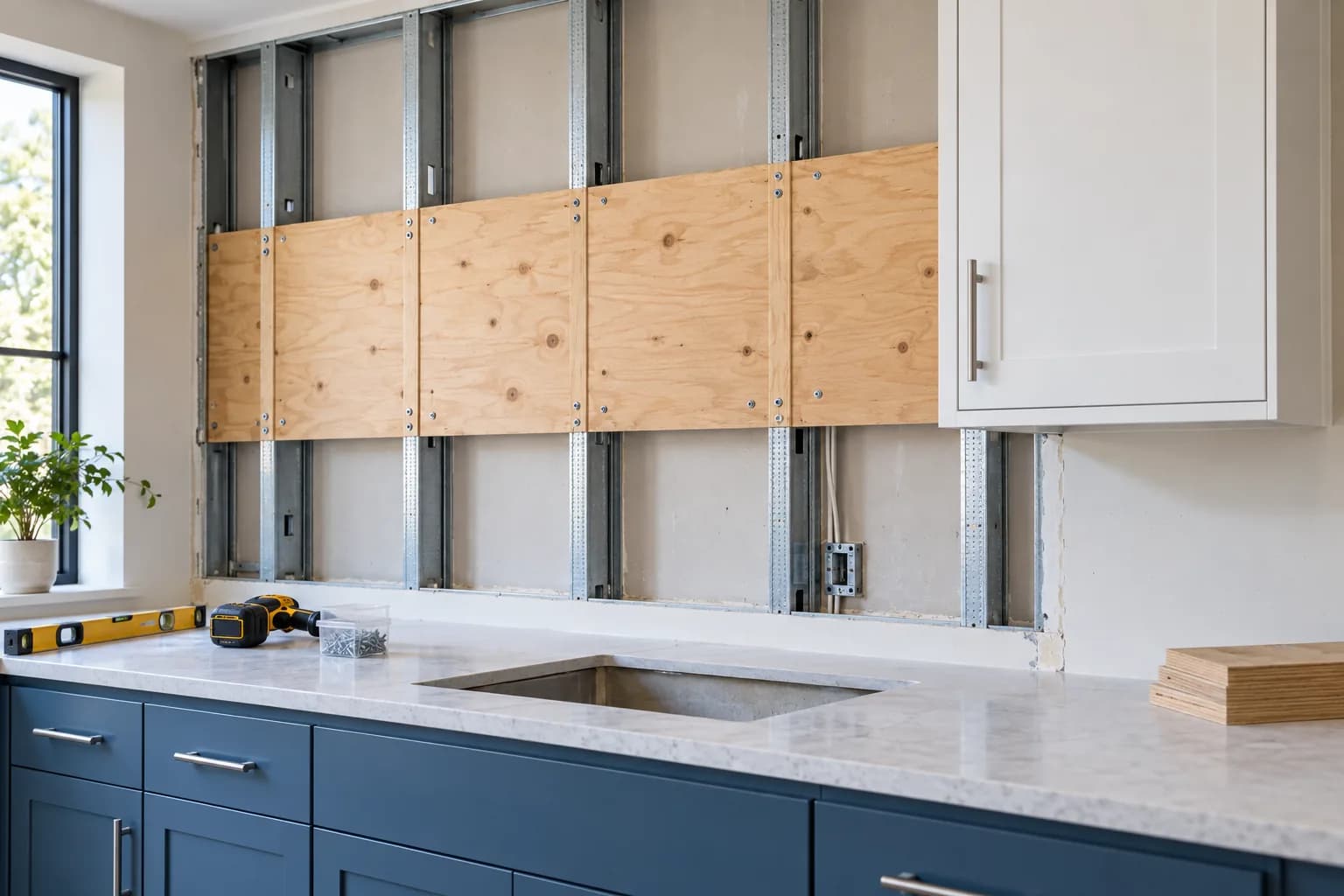
A TV on an arm, shelves, kitchen cabinets or a wall-hung wardrobe need reinforcement inside the wall: timber or a dedicated profile at the exact height. A drywall board on its own is not designed to carry a full kitchen cabinet. Mark the heights, photograph the reinforcement next to a tape measure before closing, and keep the photo for the years ahead. For cabinets see the guide to reinforcing a drywall wall for kitchen cabinets, and for a TV the guide to hanging a TV on a drywall wall.
7. Single-layer, double-layer or acoustic partition: when each is justified
It helps to think of drywall partitions as a ladder with three rungs. Each rung costs more per m², so the right question is not "which is best" but "what does this particular room need":
- Standard partition, one layer each side (228–348 ₪ per m²). Enough for dividing space when acoustic privacy is not critical: separating an entrance hall from the living room, creating a walk-in wardrobe, a work corner with no video calls while someone sleeps on the other side. Rock wool can be added as a separate line, noticeably improving the wall for relatively little money.
- Double-layer partition (336–516 ₪ per m²). Two boards on each side add mass, stiffness and impact resistance. Justified between bedrooms, in a kids' room where balls get thrown, on a wall that will carry a lot, and in a home office where calls happen. There is a detailed comparison in the guide to choosing between single- and double-layer partitions.
- Acoustic partition (384–660 ₪ per m²). A system designed entirely around soundproofing: mass, wool, sometimes separating the two sides of the frame, and sealed details around the perimeter and at the ceiling. Justified for a main bedroom next to a living room with a TV, a meeting room, a music room or work that needs quiet. See the acoustic drywall partitions page and the guide to acoustic insulation of a drywall wall.
Two things stay the same on every rung. First, sound takes the weakest path: a hollow door, a gap under the door or back-to-back sockets will limit even an expensive partition. Second, a partition between two of your own rooms is a different problem from a wall shared with neighbours, where noise also travels through the floor, the ceiling and the side walls. For that there is a separate guide to soundproofing a shared wall with neighbours.
What about blockwork?
A block wall is heavy and feels solid, but it adds load to the floor slab, needs wet plaster and drying time, and makes more mess in a home people are living in. A double-layer or acoustic drywall wall closes much of the privacy gap, and with the right details it can even outperform it. The full comparison is in the drywall vs block partition guide.
8. Drywall partition cost per square metre in practice: two worked examples
The examples below are simple arithmetic on the price-list ranges, not a quote. They show how the lines add up and why "the price per m²" is only part of the picture. In both, the area is counted gross, without deducting openings.
Example 1: dividing a kids' room with a door
A new apartment, like many in Harish or Hadera: one large room to be split into two children's bedrooms. The partition is 3.2 m long and 2.7 m high, so 8.64 m², with one door opening.
- Standard partition: 8.64 × 228–348 = roughly 1,970–3,007 ₪.
- Door opening: 900–1,620 ₪.
- Rock wool for privacy: 8.64 × 10²–192 = roughly 881–1,659 ₪.
- Skim coat on both sides (17.28 m²): 17.28 × 66–132 = roughly 1,140–2,281 ₪.
- Paint on both sides (17.28 m²): 17.28 × 54–114 = roughly 933–1,970 ₪.
Total roughly 5,825–10,536 ₪, before the door leaf and frame, electrics, air conditioning, and checking whether VAT is included. If you choose a double-layer partition instead of a standard one, the wall line becomes 8.64 × 336–516 = roughly 2,903–4,458 ₪. Light and privacy considerations for this kind of split are covered in the guide to dividing a kids' room in Harish.
Example 2: an office partition with a window
An office, say in Herzliya or Netanya, wants to close off a meeting room: a partition 5 m long and 2.8 m high (14 m²) with an interior window and a door opening.
- Office partition package: 14 × 336–624 = 4,704–8,736 ₪.
- Interior window: 1,020–1,980 ₪.
- Door opening: 900–1,620 ₪.
- Paint on both sides (28 m²): 28 × 54–114 = 1,512–3,192 ₪.
Total 8,136–15,528 ₪, before the door, glass if it is not part of the window line, electrics and air conditioning. Ask what the package includes: if there is no skim coat in it, add 28 × 66–132 = 1,848–3,696 ₪. If the room needs full speech privacy, compare with an acoustic partition as well: 14 × 384–660 = 5,376–9,240 ₪ for the wall line. Ideas for combining drywall with glass are in the guide to a glass and drywall office partition in Herzliya.
9. Finishing levels: skim coat, paint and what "paint-ready" means
A partition with boards screwed on and joints taped is not yet a finished wall. The difference between "boarded" and a wall that looks like the rest of the home is the skim-coat stage, and that is where much of the gap between similar-looking quotes hides.
Three levels worth telling apart
- Boarded only: boards fixed, tape and a first fill on joints and screw heads. Suitable if a painter or another contractor takes over from here.
- Paint-ready: several coats of filler on joints, screws and corners, and over the whole surface where needed, then sanding and a side-light check (66–132 ₪ per m² of surface). Details on the skim coat under paint page.
- Painted: usually primer and two coats (54–114 ₪ per m² of surface), ideally together with the adjoining walls so the shade matches. See interior wall painting.
Where a new partition meets an old plastered wall, painting only the partition almost always leaves a difference in shade and texture. So it is sometimes better to repaint the whole room rather than just the new wall. Also make sure the junctions with the ceiling and the existing wall get a defined detail: tape, a flexible joint or a shadow gap, so a hairline crack does not appear after a season of shrinkage and expansion.
How to check the finish
Hold your phone torch flat against the wall and shine it along the surface. Waves, proud joints and screw heads show up immediately. Look especially closely around the door, in the corners and where window light will fall. Agree in writing which finishing level you are getting, and on which sides, rather than arguing about it once the paint is already on the wall.
10. Light, ventilation and air conditioning: making the new room usable
A well-built partition can still create an uncomfortable room: dark, hot in summer and stuffy. You can see this on the plan, not after the wall is up. Before ordering, go through these points:
- Window. Each room needs light and air. The partition should meet the outside wall between windows or next to a window reveal, not cut a window in half. In new apartments in Harish and Netanya windows are often wide, and there the position of the partition is set by their dimensions rather than by splitting the room evenly.
- Air conditioning. If the AC unit stays on one side, the other room will be hot. An extra unit means an AC technician, a place for the outdoor unit, drainage and a dedicated electrical point. With a mini-central system, check that the new room gets a supply outlet and a path for return air, or it simply will not cool.
- Ventilation. A room without an opening window needs a planned ventilation solution. A closed door is not one.
- Rules and planning. A room created by a division does not always count as a room in planning terms, especially without a window. If that matters for a sale, a rental or insurance, ask an architect or engineer. In a new building, check with the developer what is allowed before handover, and do not plan any changes to the walls of the safe room (mamad).
- Offices. In Herzliya and Netanya a new office partition also affects smoke detectors, sprinklers, lighting and central air conditioning. These are coordinated with building management and the relevant contractors, and you decide up front whether the partition stops at the suspended ceiling or runs up to the slab.
A drywall contractor builds the partition and leaves openings and back boxes exactly where agreed, but cannot guarantee what depends on an electrician, an AC technician or a planning approval. A professional quote says so in writing.
11. How to divide a room with drywall and compare quotes line by line
When you have two or three quotes in front of you, do not compare the bottom line until you have brought them to the same scope. Make a simple table, one column per quote, and go line by line:
- Area: did everyone measure the same length and height? Are openings deducted?
- Partition type: standard, double-layer or acoustic, and the stud width if stated.
- Rock wool: included, a separate line or not mentioned?
- Door opening: what is on the line (reinforcement, header, fitting the frame) and who supplies the door?
- Interior window: is the glass included?
- Finish: boarded, paint-ready or painted, and on how many sides?
- Details: corner beads, free end, junctions with the ceiling and existing wall.
- Services: what the drywall contractor does (openings, reinforcement) and what belongs to the electrician and the AC technician.
- Site: debris removal and protection in an occupied home.
- VAT: included or not.
Common mistakes
- Putting a standard partition with no wool between two bedrooms and discovering you can hear everything. Wool is far cheaper at build stage than after the wall is painted.
- Building the opening before choosing the door and frame.
- Forgetting reinforcement for a TV, shelves or a wardrobe.
- Comparing a quote "including paint" with one "up to skim coat", or a one-side price with a whole-wall price.
- Assuming the per-m² rate includes debris removal and protection.
More on planning partitions so nothing has to be redone later is in the drywall partitions planning guide.
12. Next step: what to send for an accurate quote
A good estimate starts with good information. To get a quote you can trust and compare, send:
- Photos of the room from both sides, with the partition line marked on the floor in masking tape.
- The partition length and the floor-to-ceiling height at two or three points.
- The position of the door and any interior window, plus the door dimensions if you have already chosen it.
- A floor plan of the apartment or office, if you have one.
- What needs to be in the wall: sockets, a TV, shelves, cabinets.
- The level of privacy you need, and the finish: paint-ready or painted.
An online consultation and a detailed estimate from your photos and measurements are free. When the site needs to be seen, for example uneven height, an out-of-level floor, a junction with an existing suspended ceiling or services in the wall, a site survey costs 360 ₪ per visit on the price list. NikoGips works across the Haifa area and the Krayot, Hadera and Harish, Netanya, Herzliya and the Sharon towns. The full price ranges are on the prices page, and you can send photos and measurements through the contact page.
Questions
How much does a drywall partition cost per square metre?
On the NikoGips price list for November 2026, a standard drywall partition with one board layer on each side is 228–348 ₪ per m², a double-layer partition 336–516 ₪ per m² and an acoustic partition 384–660 ₪ per m². The area is length times height, and the rate covers a wall boarded on both sides. A door opening, wool, skim coat and paint are usually separate, and the final price is set after a site survey.
How much does a partition wall with a door cost?
A door opening in a partition is 900–1,620 ₪ per unit on the price list, on top of the wall area itself. That line covers framing and reinforcement around the opening, not the door leaf and frame, which are usually bought from a door supplier. For a 3.2 by 2.7 m partition with a door, the wall and opening alone come to roughly 2,870–4,627 ₪, before wool, skim coat, paint and the door.
Does the price per m² include both sides of the partition?
In most quotes, yes: the partition rate per m² covers the frame and boards on both sides, while the area is measured on one face. Skim coat and paint, on the other hand, are counted per m² of surface, so a 10 m² wall can become 20 m² of finishing. Ask for this to be written in the quote, because a very low rate is sometimes a price for one side only.
Single-layer or double-layer partition for a bedroom?
Between two bedrooms, or between a bedroom and the living room, a single-layer partition without wool usually lets conversation and TV sound through clearly. The usual recommendation is at least rock wool in the cavity, and preferably a double-layer partition with wool. When you need real quiet, such as a main bedroom next to the living room, consider an acoustic partition and deal with the door too, which is often the weak link.
Can you hang a TV or cabinets on a drywall partition?
Yes, as long as reinforcement inside the wall is planned before it is closed: timber or a dedicated profile at the exact mounting height. A drywall board on its own is not designed to carry a full kitchen cabinet or a TV on an extending arm. Mark the heights in advance, photograph the reinforcement next to a tape measure and keep the photo. Adding reinforcement after painting means opening the board and redoing the finish.
Does a drywall partition block noise as well as a block wall?
It depends on the system, not just the material. An empty single-layer partition is weaker than a plastered block wall, but a double-layer or acoustic partition with rock wool and proper perimeter sealing can come close to it and even beat it for speech privacy. Either way, a hollow door, a gap under it or back-to-back sockets will decide the result more than the wall itself.
Relevant services
Guides and practical notes
Message Nikolai on WhatsApp with photos and dimensions, or call him to discuss the next step and what is needed for an estimate.